In late September I was in Hünfeld for the retreat of ELCH (SFB 1319), the Kassel research centre on light and chiral molecules. The programme included a guided tour of the Konrad-Zuse-Museum, and I had signed up.
At the start, the guide asked who knew who Konrad Zuse was. I said no. That turned out to be a good way to begin, because almost everything after it surprised me.
Zuse lived in Hünfeld from 1957 until his death in 1995, and the town made him an honorary citizen. The museum holds one of the largest collections of his machines, several of them still working.
An engineer who also painted
The first surprise was the paintings. Zuse painted all his life, at first under the name "Kuno See", and the museum counts more than 500 oil paintings. He exhibited them, including in Hünfeld's town hall.
He also took a while to find his subject. He studied mechanical engineering, then architecture, and finally civil engineering, graduating in 1935. In between he spent a short time designing advertisements for Ford.
He never earned a doctorate. The honours came later instead: TU Berlin made him an honorary doctor in 1957, and ETH Zurich did the same in 1991.
Why he started
Zuse trained as a civil engineer. From 1935 he worked as a stress analyst at the Henschel aircraft works, where the job meant long, repetitive structural calculations.
He liked to say he was too lazy to calculate. The serious reason was that those sums followed fixed rules, and anything that follows fixed rules can be done by a machine.
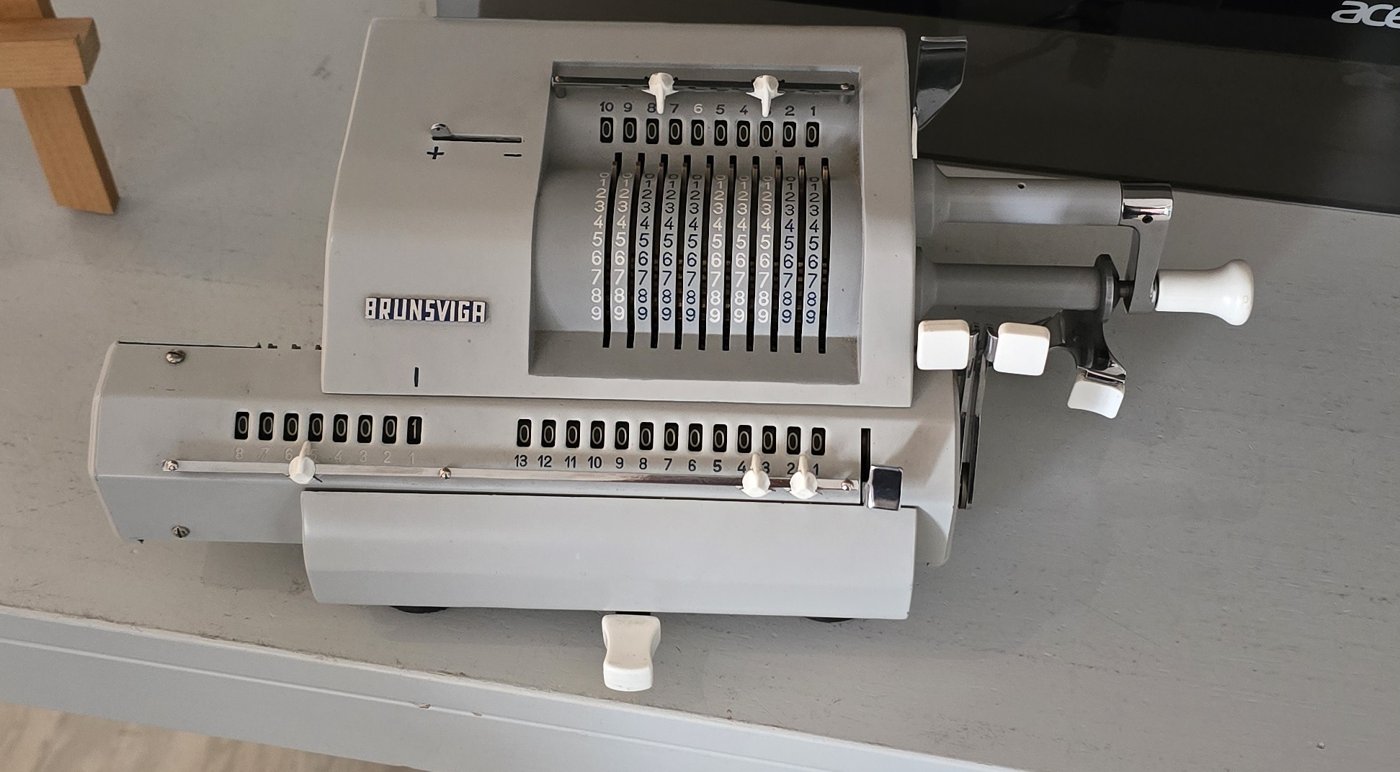
Machines like this Brunsviga were the calculators of that era. You set a number with the levers and turn the crank, and each turn adds it once. Multiplying means turning, shifting the carriage and turning again.
A computer made of sheet metal
Zuse built his first machine, the Z1, between 1936 and 1938 in his parents' living room in Berlin. It was mechanical. Its memory was a stack of thin sheet-metal plates, and it read its program from punched 35 mm film.
The parts jammed regularly. The original was destroyed in an air raid during the war. In 1989 Zuse rebuilt it himself for the Deutsches Technikmuseum in Berlin, and the replica still jams.
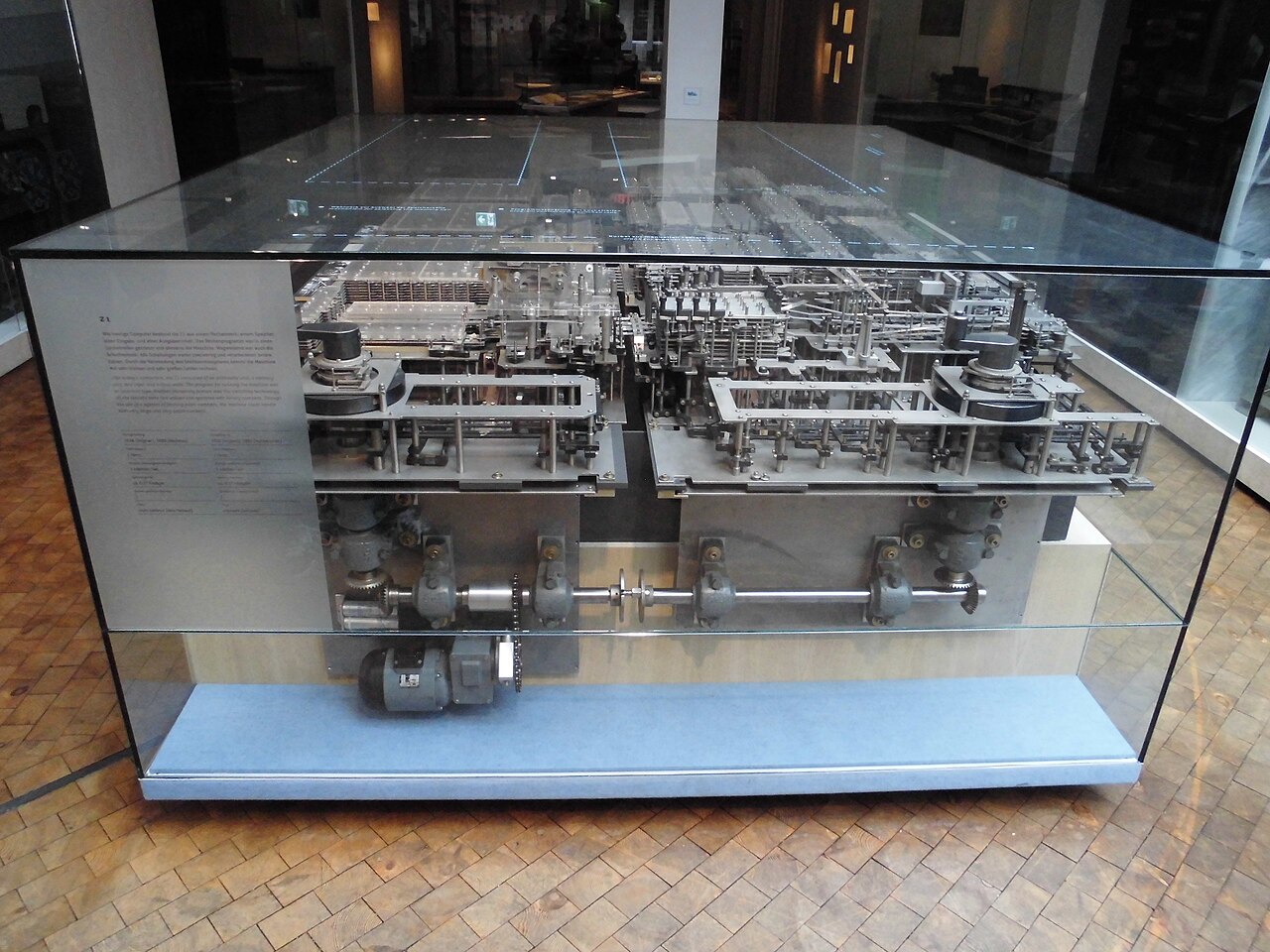
What stopped me was not the mechanics. It was that this living-room machine already worked in binary and in floating point. Every computer I use does both.
Floating point is why one program can hold numbers of very different sizes. Our spectrometer's vacuum gauges read around 10-8 mbar on one channel and 10-1 mbar on the next. The dashboard stores both without a second thought. Zuse designed for that in the 1930s.
Relays, then a machine that survived
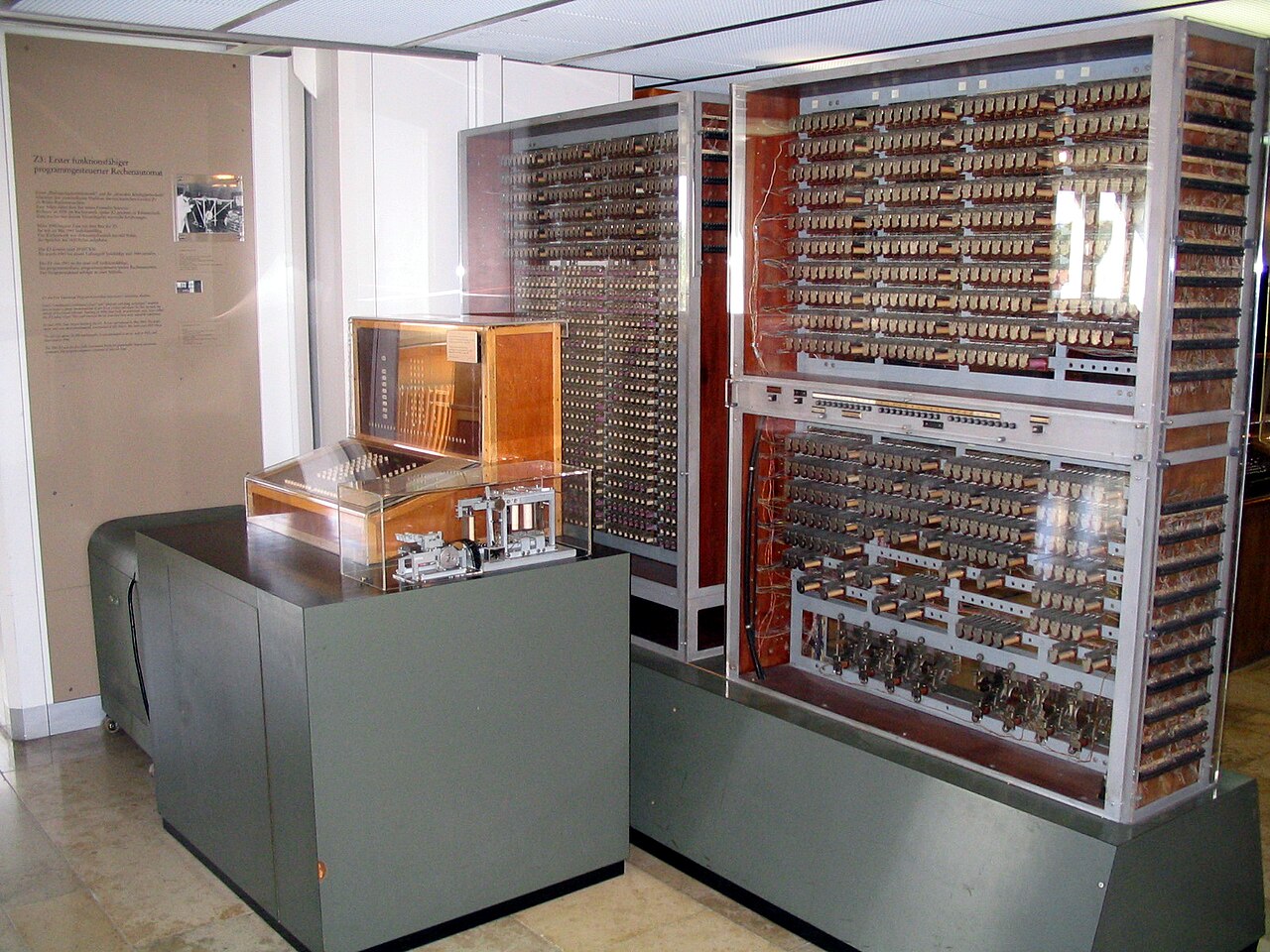
The Z3 followed in 1941, built from telephone relays. Zuse presented it on 12 May 1941, and it is widely regarded as the first working, fully automatic, programmable computer. It was destroyed in a bombing raid on Berlin in December 1943. Hünfeld has a working reconstruction.
Charles Babbage is often called the father of the computer, and for a different reason. In the 1830s he designed the Analytical Engine, a general-purpose mechanical computer. It had a memory, a calculating unit and punched-card programs. It was never built. Babbage had the design; Zuse built a machine that ran.
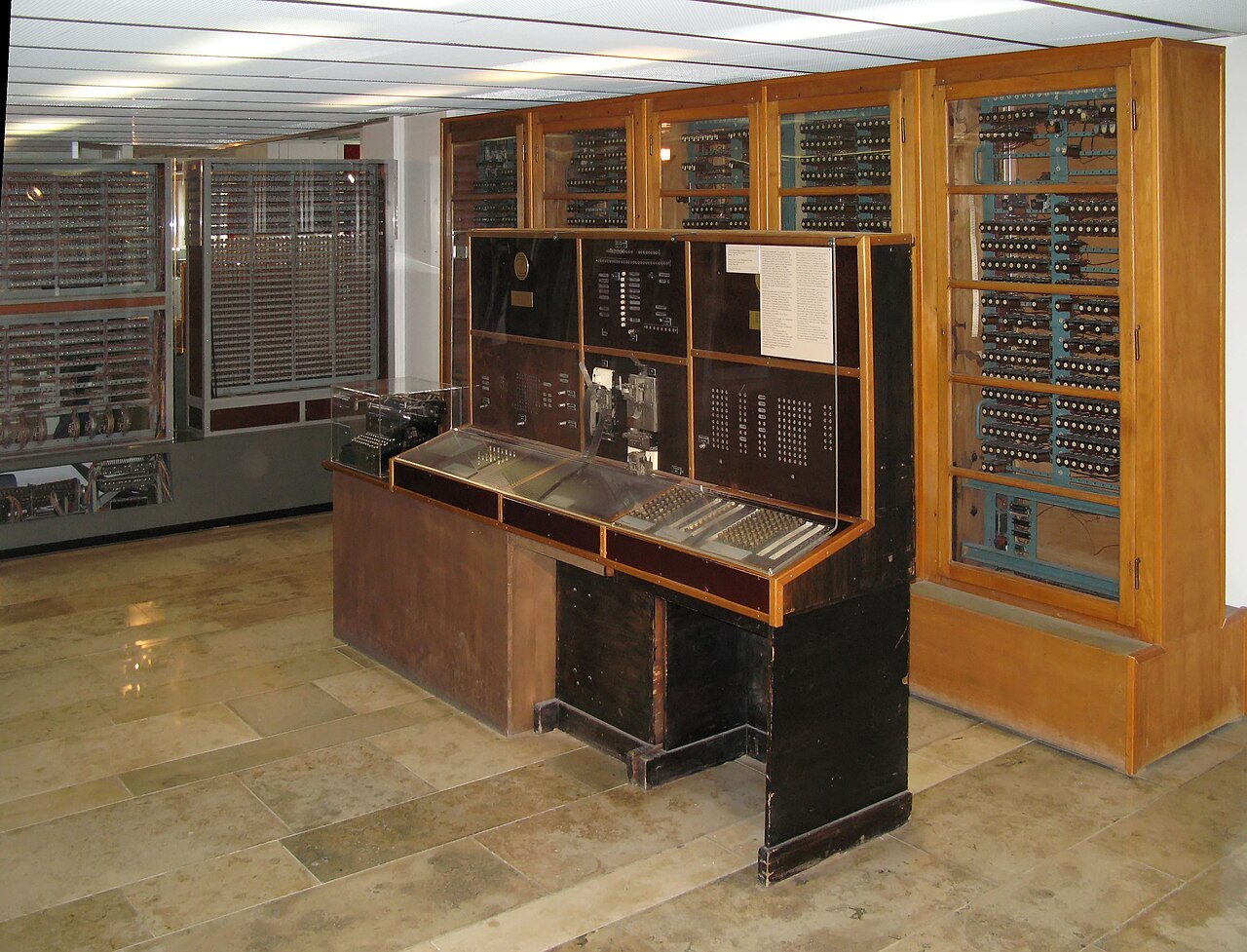
The Z4 is the one that made me smile. It survived the war, travelled by lorry to the Allgäu, and spent time in the cellar of a bakery. In 1950 ETH Zurich rented it for five years. For a while it was the only working programmable computer in continental Europe.
There is a story that the Z4 was so reliable it ran through the night without anyone watching. ETH's own historian calls that claim unbelievable. After Zuse left, a professor complained that it took two weeks before even a small calculation ran. Zuse wrote that the rattling machine gave quiet Zurich "a modest nightlife".
That part I recognise. Every instrument I have worked with has one person who knows where it rattles, and it runs best while that person is in the room.
A chess program on paper
Between 1942 and 1945 Zuse designed Plankalkül, a programming language. It is often called the first high-level language designed for a computer. To test what it could express, he wrote routines for playing chess.
No machine could run them then. Plankalkül was published in 1972, and a team at the Freie Universität Berlin ran Zuse's 1945 chess code for the first time in 2000. Raúl Rojas, who led that work, calls it the first real chess program.
I wanted to draw a straight line from there to IBM's Deep Blue, which beat Garry Kasparov in 1997. There is no such line. Deep Blue was IBM's own special-purpose machine. What Zuse had in 1945 was the idea that a game can be written down as an algorithm. No computer could play it yet.
From one inventor to Siemens
After the war Zuse started a company, Zuse KG, near Hünfeld. It built machines in series: 56 of the vacuum-tube Z22, delivered from 1958, then 98 of the transistor Z23. Building computers in series takes a lot of capital, and the company ran into debt.
The guide told one story I had to check afterwards, because it sounded too small to matter. For the Z25, Zuse KG used a new type of transistor that needed a special soldering method. That requirement was overlooked in development, or the component maker did not pass it on in time.
Around 1963, machines worth about 20 million marks stood in the factory and could not be delivered. Together with the unsuccessful Z31, the losses helped end the company. As an experimentalist I know the feeling: one detail nobody wrote down, and a whole system stops.
In 1964 Zuse gave up his shares and Brown Boveri took over. Siemens took a majority in 1967 and the rest by 1969. The Zuse KG name was deleted in 1971.
One machine from those years made me think of design offices. The Graphomat, from 1961, was an automatic drawing table. It drew points and curves from punched tape, for surveying, civil engineering and the textile industry. Early computer artists such as Georg Nees and Frieder Nake made some of the first computer drawings with it.
Memory you could hold in your hand
The Z23 kept its fast working memory in ferrite cores: tiny magnetic rings, each one bit, with fine wires threaded through them. Core memory was threaded by hand, under a magnifier.
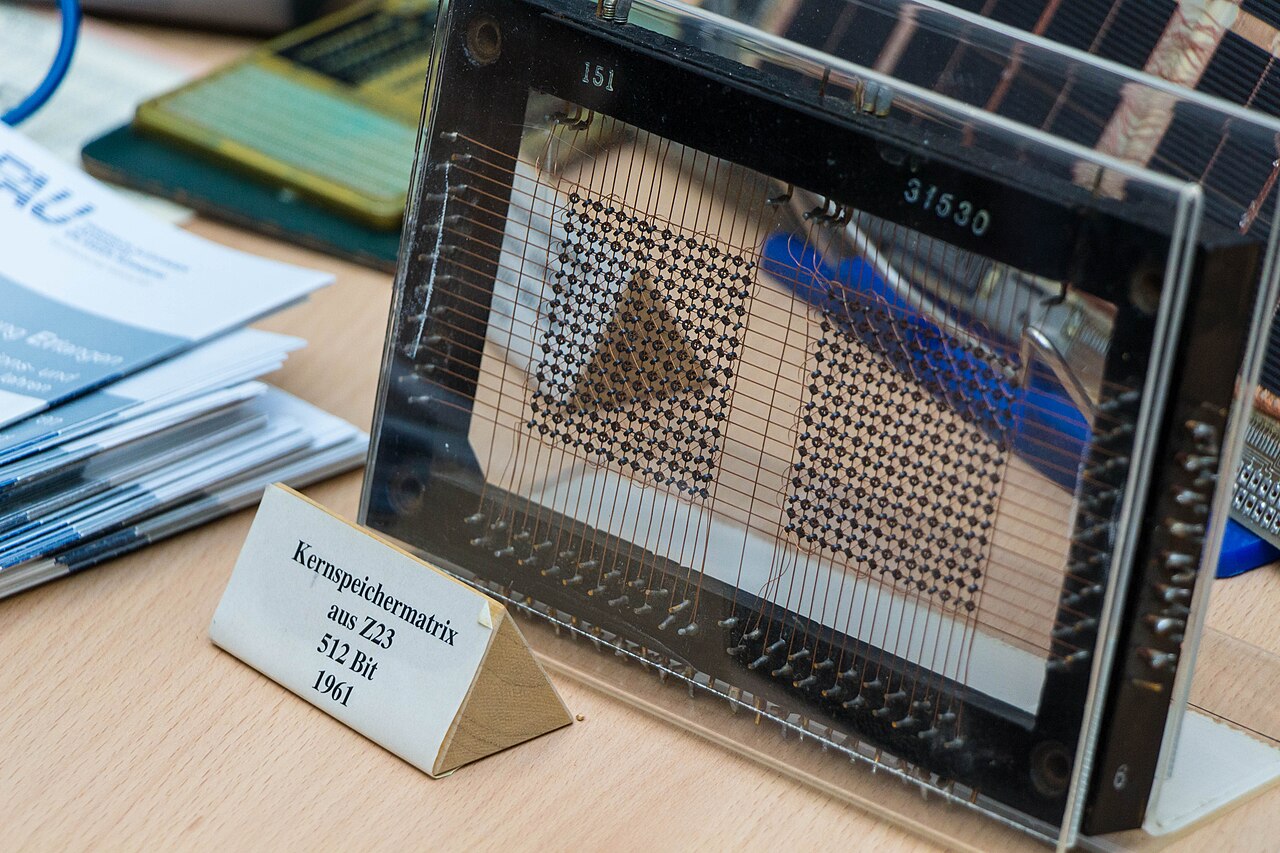
The matrix in that photo holds 512 bits, which is 64 characters. That is less than one line of this post.
Elsewhere in the museum, a silicon wafer showed where memory went next. Each small rectangle on it is a chip. The labels beside it show single chips of 2 K-bit, 64 K-bit and more.
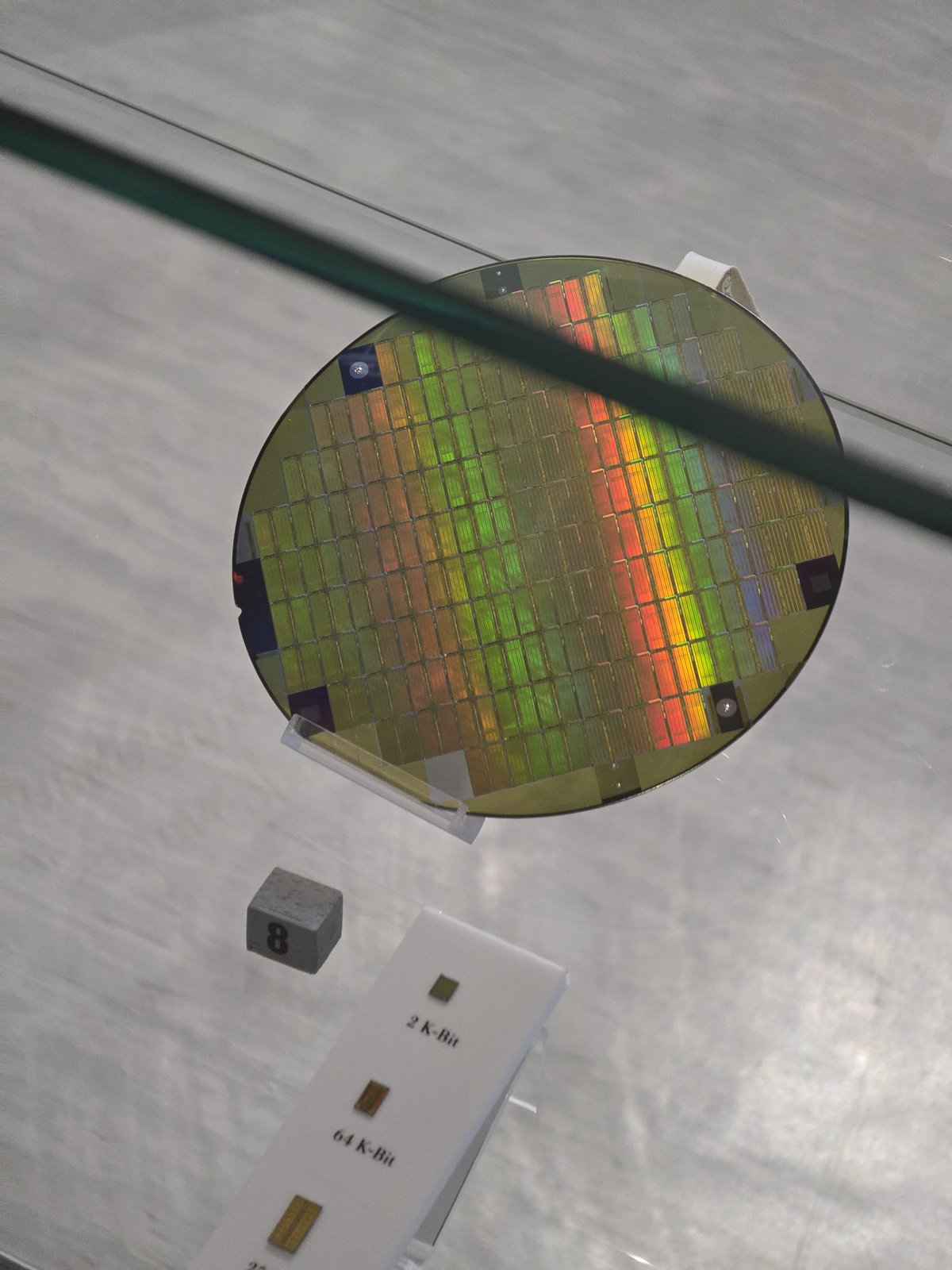
One 64 K-bit chip holds as much as 128 of those hand-threaded core matrices. The rainbow across the wafer is diffraction: the chips repeat like the lines of a grating and split white light into colours. It is the same physics as the gratings in our laser.
The idea I took home
In 1969 Zuse published Rechnender Raum, "Calculating Space". In it he proposed that the universe itself might be computed, step by step, like a cellular automaton. It is an early version of what physicists now call digital physics.
He kept inventing to the end. In his eighties he designed a tower that builds itself up segment by segment, and patented it in 1992.
I spend my days on instruments that measure single electrons and ions, and on the software that turns their signals into numbers. Walking out of that museum, I kept thinking that the man who built the first of those machines also wondered whether physics is a computation.
Sources: Konrad-Zuse-Museum Hünfeld, Konrad Zuse; H. Bruderer, Konrad Zuse und die Schweiz (ETH Zürich, 2011); R. Rojas, The reconstructions of Konrad Zuse's Z3 computer; R. Rojas, Plankalkül at FU Berlin; IBM, Deep Blue; H. Zuse, Z22, Z23 and Z25; Heinz Nixdorf MuseumsForum, Siebzig Jahre Zuse KG; TU Berlin, Catalogus Professorum: Konrad Zuse; Osthessen News on Zuse the painter.
Photos from Wikimedia Commons: Z1 replica by Morn, CC BY-SA 3.0; Z3 replica by Venusianer, CC BY-SA 3.0; Z4 by Clemens Pfeiffer, CC BY 2.5; Z23 core memory by Kai Wegner, CC BY 2.0. Resized, otherwise unchanged. The Brunsviga and the memory wafer are my own photos.


.jpg)