30 October 2025 - ~11 min read
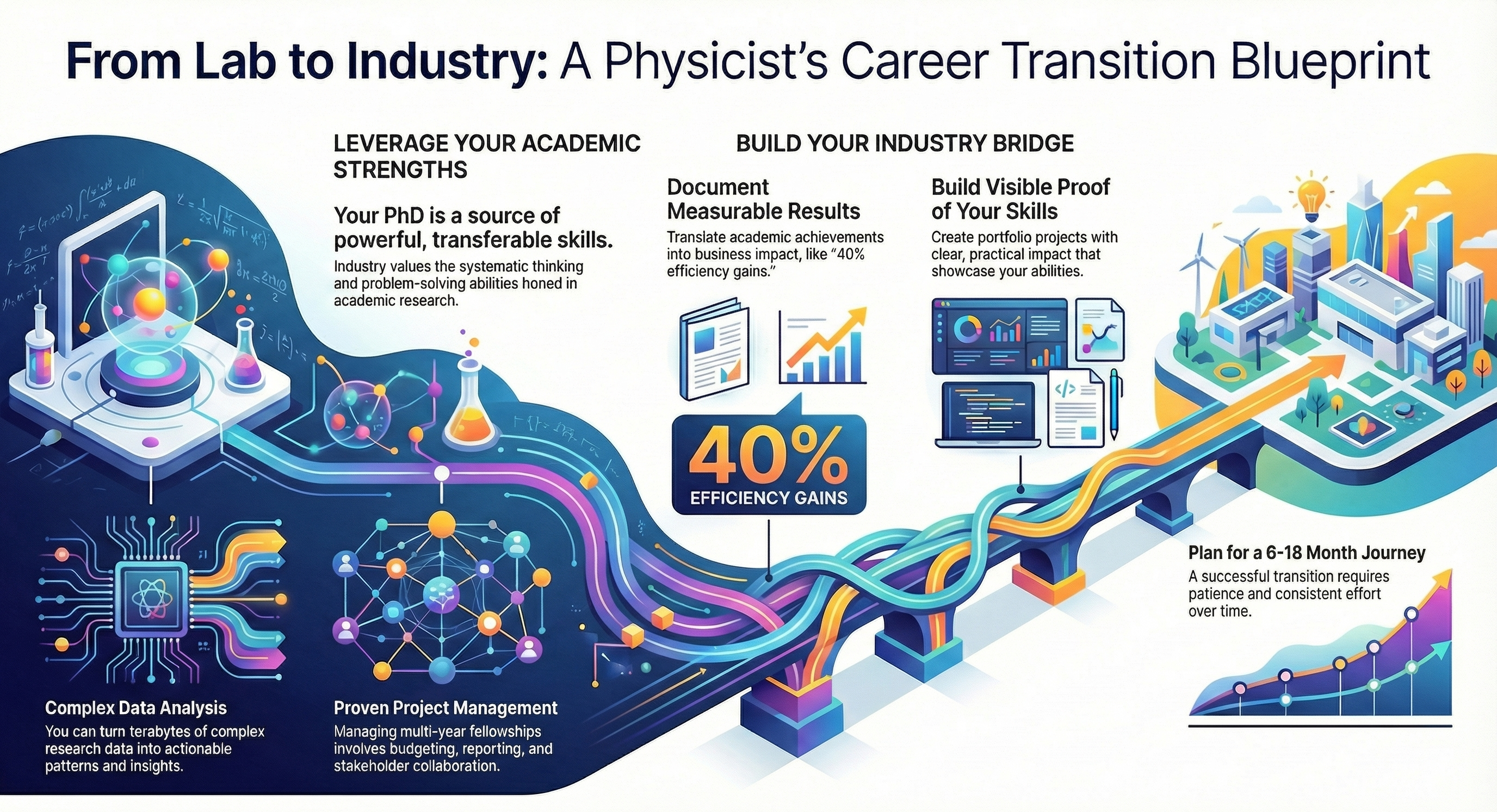
Career Transition: Comprehensive overview and key takeaways
After more than eight years in academic physics, completing a PhD in India and a postdoc in Kassel, building 24 publications including multiple first‑author papers, I am actively moving into industry. My focus is on R&D, instrumentation, and data-science roles in the DACH region, bringing data science, automation, and AI as the tools I work with, where rigorous analysis and practical impact matter more than citation counts.
This post shares what is working, what remains difficult, and how physicists can navigate a similar transition with realistic expectations.
Why I decided to move
The decision to leave (or at least step away from) the academic track emerged gradually.
Key drivers:
- Narrow academic paths and structural uncertainty - Tenure‑track positions are scarce, and long chains of short‑term contracts make planning a stable life difficult.
- Funding pressure - Success increasingly depends on grant strategy and administrative navigation rather than deep, focused research alone.
- Desire for broader impact and balance - Applying quantitative skills to industrial problems in energy, manufacturing, or software offers clearer feedback and more sustainable career trajectories.
Rather than viewing this as "leaving science," it helps to frame it as taking scientific training into a different ecosystem.
Transferable skills that actually matter
Years in the lab may not translate directly to job titles, but they do translate to capabilities that industry values.
Some of the most important ones:
- End‑to‑end problem solving with data - Designing experiments, controlling variables, and analyzing noisy signals is structurally similar to building data pipelines and models in industry. In spectroscopy, processing and interpreting large datasets cultivates skills in statistics, regression, uncertainty estimation, and visualization.
- Automation and tooling - Scripted control of instruments, automated analysis, and GUI tools in Python or LabVIEW often reduce processing times by 40–90% compared to manual workflows. These achievements can be reframed as "productivity improvements," a language hiring managers understand.
- Robust debugging and system thinking - Diagnosing misalignments in a laser setup or instabilities in a UHV system is close in spirit to debugging distributed systems or complex workflows. The habit of forming hypotheses, testing them systematically, and documenting outcomes is universally valuable.
- Project ownership and collaboration - Leading multi‑year experimental projects and international collaborations trains skills in planning, communication, and stakeholder alignment. These experiences map well onto R&D, data-science, and technical project roles in the DACH region.
My concrete steps in late 2025
To make the transition credible, I am aligning my day‑to‑day activities with the expectations of data‑driven and technology‑focused employers.
Ongoing steps:
- Targeted certifications and structured learning - Data and AI: vendor‑agnostic foundations plus practical programs (e.g., IBM or similar data science tracks) for hands‑on experience with Python, SQL, and basic ML workflows. Project management: certification paths that emphasize agile, stakeholder communication, and risk management. SAP and technology consulting: understanding core enterprise systems widely used in the DACH region.
- Building a visible portfolio - Publishing analysis tools, small GUIs, and reproducible pipelines to GitHub, including documentation and tests. Showcasing translated research problems (such as time‑series modeling or anomaly detection) using open datasets.
- Networking in the right places - Maintaining an active LinkedIn presence with clear positioning: "Physicist moving into instrumentation, R&D, and applied data roles in DACH." Attending local meetups, online communities, and alumni events where hiring managers and practitioners actually gather.
- Focused applications - Target sectors that naturally value physics skills: manufacturing, energy, automotive, materials, and technical consulting in Germany, Austria, and Switzerland. Treat each application as a small project: tailored CV, translated achievements into business metrics, short and clear cover letter.
This approach is slower than "spray and pray" job hunting, but it builds a coherent narrative.

Photo by Marvin Meyer on Unsplash
Challenges that are harder than expected
Several parts of the transition require deliberate effort:
- Translating academic output to business impact - A paper that took two years to publish may be perceived as "just a PDF" unless it is reframed in terms of throughput gains, cost savings, or risk reduction. Learning to quantify impact ("reduced analysis time by 80%," "increased data reliability by 30%") is essential.
- Adapting to new tools and culture - Version control, code review, ticket systems, and product roadmaps are not always part of academic training. Industry often values shipping something imperfect but useful over polishing a result indefinitely.
- Competition and signal vs noise - Data and AI roles in DACH receive applications from computer scientists, engineers, and experienced practitioners. A PhD title alone is not enough; concrete projects and communication skills often differentiate successful candidates.
Acknowledging these realities early helps set a realistic 6–18 month timeline for a full transition rather than expecting immediate results.
Practical advice for physicists considering the move
For others in a similar stage, a few guiding principles can make the journey smoother:
1. Quantify everything you can - Replace "developed a data processing script" with "automated data processing, reducing manual analysis time from two days to two hours per dataset." Connect your work to reliability, speed, quality, or safety.
2. Ship visible proof, not just credentials - A clean GitHub profile with three or four well‑documented projects is more persuasive than a long list of finished courses. Include clear READMEs, sample data, and short write‑ups of decisions and trade‑offs.
3. Align with regional strengths - In the DACH region, automotive, advanced manufacturing, energy, materials, and consulting dominate demand for analytical talent. Tailor examples and projects to these domains when possible.
4. Expect and plan for uncertainty - A 6–18 month transition window is realistic for a deliberate pivot, especially when moving across sectors and countries. Maintaining some research momentum or part‑time consulting can help bridge the financial and psychological gap.
The core message: physics training is not wasted; it needs translation, packaging, and a clear direction.